Freemasonry, the Great Work, and the Grammar of Transformation
This essay approaches transmutation from the standpoint of universal initiation, with Freemasonry as its primary working example. It stands alongside our later four-part reflections on the Christian and sacramental fulfillment of the Great Work (The Great Work of Transmutation), but is meant to preserve the broader initiatic grammar in its own right. – Phillip A. Garver, T. Vincent II
You received a stone and were told to work it. That simple instruction, given to every Entered Apprentice, conceals one of the oldest and most precise descriptions of human transformation ever developed. Freemasonry rarely calls this work alchemy, yet it preserves the same symbolic grammar.
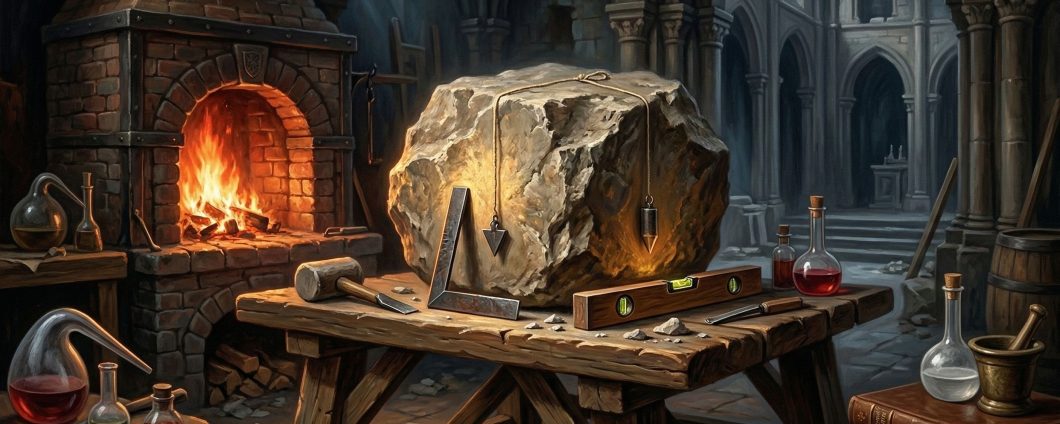
When most people hear the word “alchemy,” they imagine medieval charlatans trying to turn lead into gold. The deeper alchemical tradition was concerned with something far more valuable: the transformation of the human person from raw material into something capable of bearing light. Freemasonry expresses the same process through architectural rather than chemical symbols. The rough ashlar corresponds to the prima materia. The working tools correspond to the operations of refinement. The Temple corresponds to the completed work.
This is not an accidental resemblance. It is part of a wider initiatic inheritance that Freemasonry preserves with unusual clarity.
The Mason and the Alchemist: Speaking the Same Language
Walk into any lodge, and you’ll see symbols of transformation everywhere. The candidate enters in darkness and seeks light. The stone moves from roughness toward fitness. The initiate advances through degrees, each one revealing what the previous one prepared. This is alchemical logic expressed through architectural symbols.
The alchemists described transformation in stages: nigredo (blackening), albedo (whitening), citrinitas (yellowing), and rubedo (reddening). These aren’t about chemicals. They describe states of consciousness. The blackening is confusion and dissolution. The whitening is purification and clarity. The yellowing is the first glimmer of gold. The reddening is completion, the capacity to transform others.
Freemasonry presents the same progression, just more clearly. The Entered Apprentice degree emphasizes purification and preparation. The Fellowcraft degree concerns study, skill development, and ascending toward knowledge. The Master Mason degree confronts death, transformation, and the capacity to raise others.
Different symbols. Same pattern. Both systems understand that transformation happens in stages, not all at once.
The Stone as Self
Masonic ritual gives you a stone and tells you it represents yourself. This is pure alchemy. The alchemists didn’t care about rocks. They cared about people. When they wrote about transmuting lead into gold, they were describing how to transform a heavy, dull, corruptible human being into something refined, luminous, and incorruptible.
The rough ashlar isn’t just any stone. It’s quarry stone, cut from the earth but not yet shaped for its purpose. It has potential but no form. Apply the square, the level, and the plumb rule (judgment, equality, and uprightness), and it becomes fit for the temple.
In alchemy, the work follows the same pattern. You take raw material (your inherited nature, your habits, your unexamined life) and subject it to fire (attention), water (purification), air (inspiration), and earth (grounding). What emerges is the philosopher’s stone, not because it’s hard or valuable, but because it can transmit transformation to whatever it touches.
Both traditions insist on the same truth: you are the stone, and you are also the worker. No one else can undertake this labor in your place.
The Interior Temple and the Sacred Vessel
One of the most misunderstood teachings in Freemasonry is that the temple is interior. Modern Masons sometimes reduce this teaching to a moral metaphor, as if the “interior temple” simply meant being a better person. Alchemical language sharpens the claim. The initiate is constructing an interior architecture capable of containing, ordering, and transmitting spiritual force.
The alchemist’s laboratory wasn’t primarily a room with equipment. It was a disciplined consciousness. The athanor (furnace) represented sustained attention. The retort (vessel) represented the capacity to contain difficult psychological states without collapsing or exploding. The fire represented intentional focus. The circulation of materials described the movement of energy within a properly ordered interior life.
Freemasonry teaches the same structure through different symbols. The lodge room is laid out as a sacred space, oriented to the cardinal directions, with specific stations for specific functions. When you learn to visualize this, you’re learning to construct an interior temple where transformation can safely occur.
This is why Masonic ritual emphasizes preparation, proper arrangement, and correct positioning. You’re not learning theater. You’re learning how to create interior order that can sustain real transformation.
Historical Threads: The Alchemical Roots of Masonic Symbolism
Freemasonry’s connection to alchemy isn’t speculation. It’s a historical record.
In 17th- and 18th-century Europe, the same people were often involved in both. Elias Ashmole, initiated into Freemasonry in 1646, was one of England’s most prominent alchemical philosophers. His 1652 work Theatrum Chemicum Britannicum collected English alchemical poetry, and his papers show clear parallels between alchemical symbolism and Masonic teachings.
Jean-Baptiste Willermoz, who shaped French Freemasonry’s esoteric direction in the late 1700s, explicitly understood Masonic ritual as a form of Christian alchemy. His Rectified Scottish Rite preserves this connection, presenting the degrees as stages of alchemical purification leading to spiritual reintegration.
The Rosicrucian manifestos of the early 1600s, which influenced Freemasonry’s symbolic development, describe a fraternity dedicated to universal reformation through alchemical wisdom. Their symbolic language (the rose and cross, the invisible college, the vault of Christian Rosenkreuz) appears throughout Masonic ritual and high degree systems.
Even the mainstream Craft degrees preserve alchemical patterns. The three principal officers (Worshipful Master, Senior Warden, Junior Warden) govern wisdom, strength, and beauty. These are the three alchemical principles (sulfur, salt, mercury) under different names. Sulfur is active consciousness. Salt is stable form. Mercury is transformative capacity. Put them together correctly, and you get the philosopher’s stone. Put them together incorrectly, and you get chaos. Of course, the alchemists understood that chaos itself has its uses. Sometimes the work requires breaking down existing order to create the conditions for a higher synthesis. Order from chaos, as the adept says, is itself an alchemical operation.
In alchemical thought, the temple itself was understood as a sacred vessel. Solomon’s Temple wasn’t just architecture. It was a physical diagram of how to contain divine presence. This is why alchemists obsessed over temple proportions and why Masonic ritual emphasizes proper measurement. None of this means that Freemasonry is simply disguised alchemy, still less that every Masonic symbol has a single alchemical meaning. It means, rather, that both traditions share a common initiatic concern: how raw human material is brought into order, clarified, and prepared to receive light.
The Three Degrees as Alchemical Operations
The structure of Craft Masonry follows alchemical logic with remarkable precision.
The Entered Apprentice degree concerns preparation and purification. In alchemy, this is the nigredo, the blackening. The candidate enters in darkness and seeks light. He confronts his own ignorance. He makes a commitment to the work. This is the necessary dissolution that must precede all transformation.
The Fellowcraft degree concerns instruction and ascent. In alchemy, this is the albedo, the whitening. You climb the winding staircase. You study the liberal arts and sciences. You receive wages (knowledge, skill, capacity). You’re being refined and educated. The rough material is becoming workable.
The Master Mason degree concerns death, transformation, and resurrection. In alchemy, this is the rubedo, the reddening. The candidate confronts mortality directly through dramatic symbolism. He undergoes symbolic death and is restored to life. He emerges capable of doing for others what was done for him. This is the completion of the alchemical work, the achievement of the philosopher’s stone.
This is more than a coincidence or clever comparison. It is the same initiatic pattern expressed through related symbolic systems. Both alchemy and Freemasonry insist that transformation requires confrontation with ignorance, disciplined acquisition of knowledge, and ultimately a surrender of the old form so that a new one may emerge.
The Fire of Attention
Alchemical texts constantly emphasize the importance of fire. Modern readers often assume that this means literal fire alone. In the deeper symbolic register, it means attention.
Transformation requires sustained, disciplined, focused attention on the work. This is why alchemists insisted on tending the fire constantly. Let it go out, and the work collapses. Let it burn too hot, and the material is destroyed. The art lies in maintaining the correct intensity over time.
Freemasonry teaches the same principle through repetition. You attend lodge regularly. You memorize ritual. You practice the same forms again and again. This isn’t a pointless tradition. It’s the fire that makes transformation possible.
Without sustained attention, Masonic ritual becomes empty theater. With sustained attention, it becomes an alchemical operation. The difference is whether you’re actually doing the work or just going through motions.
Some Masonic traditions have preserved this alchemical principle by requiring candidates to demonstrate their work between degrees through written reflection and oral presentation before the lodge. This practice, once more common, ensures that advancement reflects actual transformation rather than mere attendance. Research journals like this one serve a similar function, preserving and transmitting the kind of sustained intellectual engagement that makes the fire of attention effective.
From Gateway to Greater Mysteries
Craft Freemasonry can be understood as foundational initiatic work. It establishes symbolic thinking, moral discipline, and interior focus. It prepares the vessel.
Beyond the Craft, many appendant and related bodies develop themes already present in the lodge. Some emphasize priestly symbolism. Others expand philosophical instruction. Still others work more explicitly with Rosicrucian, Hermetic, or alchemical imagery. These should not be seen as arbitrary additions, but as different elaborations of a grammar already present in the Craft.
These aren’t separate traditions awkwardly attached to Freemasonry. They’re developments of the same alchemical logic that governs the Craft degrees. They assume you’ve built the interior temple and are ready to do more complex work within it.
This is why rushing through the degrees is alchemically impossible. You can get the titles, but not the transformation. The work takes time because real transformation takes time. The furnace must be properly built before you can kindle the fire.
The Continuing Work
Alchemical texts are clear: the work never ends. You complete one stage only to discover it was preparation for the next. The stone is refined, set in place, and then discovered to require further polishing. This isn’t failure. It’s fidelity to what transformation actually requires.
Freemasonry operates on the same principle. There’s no graduation. The work continues throughout your life. Each time you witness a degree, you see something new. Each time you memorize a ritual, you understand it differently. Each time you practice the work, you discover another layer.
The rough ashlar remains before you. The working tools remain in your hands. The temple remains unfinished. This is the alchemical life: sustained transformation through disciplined attention to the work.
The Universal Pattern: Alchemy Beyond Freemasonry
To understand why alchemy is truly a universal language of initiation, we need to look beyond Freemasonry and examine the same patterns at work in other traditions. The alchemical stages aren’t unique to Masonry. They describe a fundamental pattern of human transformation that appears wherever serious initiatic work occurs.
Christian mysticism shows the same pattern. The dark night is a form of nigredo, the illuminative way a form of albedo, and the unitive way a form of rubedo. The vocabulary differs, but the structure remains: transformation of consciousness through sustained spiritual discipline.
In chivalric orders, the pattern appears again. Squires begin in service and discipline, learning the basic arts while their character is tested (nigredo). They study the code of chivalry, develop skill in arms, and prove themselves worthy (albedo). Finally, through the ritual of dubbing, they die to their old identity and are raised as knights, capable of defending others and upholding justice (rubedo). The vigil is the athanor. The oath is the fire. The transformation is real.
Eastern traditions show the same structure. The Buddhist path begins with recognizing suffering and impermanence (nigredo), proceeds through ethical discipline and meditation practice (albedo), and culminates in enlightenment and the capacity to guide others (rubedo). The meditation cushion is the laboratory. Attention is the fire. The practitioner is both the alchemist and the substance being transformed.
Even ancient mystery religions followed this pattern. The Eleusinian Mysteries began with purification rituals (nigredo), proceeded through revelation of sacred objects and teachings (albedo), and concluded with the epopteia, the highest vision reserved for those who had completed the lesser mysteries (rubedo). The initiate descended into symbolic death and emerged transformed.
The genius of alchemical language is that it provides a precise symbolic vocabulary for describing this universal initiatic pattern without requiring specific theological commitments. Whether you call the goal union with God, enlightenment, self-realization, or the philosopher’s stone, the work follows the same essential stages. You begin in confusion. You submit to discipline. You are transformed. You become capable of transforming others.
This is why alchemy was adopted by so many different traditions in medieval and Renaissance Europe. Christian Hermeticists, Jewish Kabbalists, and Islamic Sufis all used alchemical symbols to describe their respective paths. The symbols were flexible enough to accommodate different theological frameworks while preserving the essential initiatic logic.
Why Freemasonry Preserves This Language So Effectively
Given that alchemy describes a universal pattern, what makes Freemasonry particularly effective at preserving and transmitting this symbolic grammar?
First, Freemasonry strips away the theological specifics while keeping the initiatic structure. You don’t need to be Christian, Jewish, Muslim, or Buddhist to be a Mason. You need to believe in Deity and immortality, but the specifics are left to you. This means Masonic ritual can focus purely on the alchemical transformation itself, making the pattern visible without theological overlay.
Second, Freemasonry uses concrete, universal architectural symbolism. Everyone understands building. Everyone grasps the difference between rough and polished stone. The temple is a symbol that works across cultures and eras. This makes the alchemical operations accessible to people who might find chemical or mystical imagery obscure.
Third, Freemasonry is structured as a progressive system with clear stages. The three degrees aren’t arbitrary. They map precisely onto the alchemical operations: dissolution, purification, and perfection. This gives practitioners a framework for understanding where they are in the work and what comes next.
Fourth, Freemasonry balances theoretical knowledge with embodied practice. You attend lodge. You memorize ritual. You practice the same forms again and again. But the repetition is informed by study and reflection – the work is both intellectual and experiential. This is exactly what alchemical texts prescribe: sustained attention combining theory and practice over time. The transformation happens through doing the work, not merely reading about it, but genuine doing requires understanding what you’re doing and why.
Fifth, Freemasonry creates a contained sacred space (the lodge) where the work can be carried out safely. This is the athanor, the furnace, the properly prepared vessel. Without it, the fire of attention dissipates. With it, transformation becomes possible.
Finally, Freemasonry maintains the principle of transmission from person to person. You can’t initiate yourself. You must be raised by someone who was raised before you. This preserves the alchemical insight that transformation isn’t purely individual. It requires connection to a living tradition, to people who embody what you’re trying to become.
Freemasonry does not own the alchemical pattern. It is one expression of something older and more widespread. Yet it may be one of the clearest and most accessible expressions still available in the modern West. You don’t need to join a monastery, become a knight, or find an enlightened guru. You need to petition a lodge, learn the ritual, and do the work.
Reading the Symbols
Understanding Freemasonry as one expression of a universal alchemical grammar doesn’t require joining exotic orders or studying obscure texts. It requires paying attention to what’s already in front of you.
The symbols speak for themselves if you know the grammar. The stone is material for transformation. The tools are methods for working on it. The temple is the goal, and you are the temple. The degrees are stages of an alchemical operation designed to refine consciousness itself.
This symbolic grammar underlies not just Freemasonry and alchemy, but the entire Western initiatic tradition and beyond. Christian mystics describe the same transformation using theological language. Chivalric orders express it through service and valor. Buddhist practitioners work through the same stages using different methods. But they all describe the same fundamental pattern: from rough to perfected, from ignorance to knowledge, from mortal to immortal.
Freemasonry’s genius lies in presenting this universal grammar through symbols that can be grasped at multiple levels while remaining accessible to ordinary people. A new Entered Apprentice can understand “work on yourself” as moral improvement. A longtime Master Mason can understand it as an alchemical transformation. A scholar of comparative mysticism can recognize the same pattern appearing across traditions. All are correct. The symbols contain all these meanings and more.
This is why Masonic ritual has endured. It’s not folklore or empty tradition. It’s a precise symbolic technology for human transformation, preserved in a form that ordinary people can practice in ordinary lives. You don’t need a laboratory or a monastery. You need the Lodge, the ritual, the symbols, and sustained attention to the work they describe.
The gold the alchemists sought was never merely in the retort. It was in the alchemist. The Temple the Masons build is not only a memory of Jerusalem, but an interior architecture of transformation. The symbols remain because the work remains. And if the work is truly undertaken, the transformation they describe is not imaginary, but real.
