Begin Your Journey from Anywhere
A life of prayer, study, and formation can begin where you are. The Wayfarer path supports those drawn to The Old Templar Church who live at a distance from its gatherings or cannot attend regularly in person.
Through personal guidance, sustained practice, and connection with the Church, you can explore this Christian tradition within the circumstances of your own life. An initial conversation gives you room to ask questions before undertaking a longer commitment.
Begin with a Conversation
You may already be a practicing Christian, be returning after time away, or be encountering sacramental Christianity for the first time. Your previous experience and present questions help shape the next step.
Tell us what draws you to the tradition, whether you have been baptized or confirmed, and what distance participation would mean for you. You can ask about the path without enrolling in a three-year program or committing to a religious vocation.
If you wish to continue, a formation mentor can guide discernment and help establish a realistic rhythm of prayer, study, reflection, and communication.
Companion Preparation and Wayfarer Membership
Those preparing for reception into the Church may begin as Companions. This period gives space to learn the tradition, develop a sustainable practice, and discern readiness for the appropriate next step.
A home Rite of Dedication may mark commitment to this preparation at a time agreed with the mentor. Dedication does not itself confer Church membership, a sacrament, or religious profession.
Appropriate sacramental reception is arranged in person with clergy, according to the person’s background and readiness. Valid Christian Baptism already received with water and the Trinitarian formula is recognized and is not repeated. Where Baptism, Confirmation, or formal Reception is appropriate, clergy help plan the preparation and ceremony.
After reception, members who continue their Church life at a distance participate as Wayfarers. Wayfarer life is full Church membership lived within dispersed circumstances.
The Structured Lesson Sequence
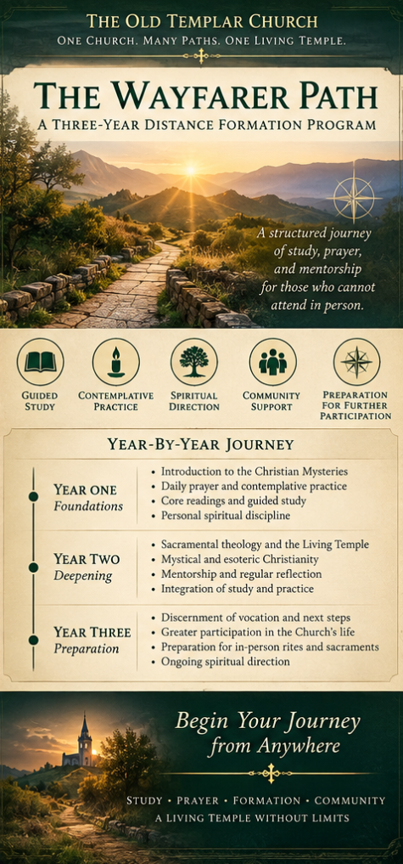
The Wayfarer resources are organized as a three-year sequence of lessons, each part building on the practice and understanding developed before it. These year labels describe the curriculum’s ordinary organization. A mentor considers each participant’s previous formation, present understanding, sustained practice, and circumstances when establishing an appropriate timetable. The required lesson work remains substantive, while completion may take different people different lengths of time.
Year One: Foundations
The first year introduces the tradition’s Christian and Chevillonian foundations. Guided study, the Daily Office, contemplative practice, reflection, and an introduction to the liturgical year help establish a rhythm that can be lived consistently.
Year Two: Deepening
The second year deepens sacramental and contemplative understanding. Participants reflect on the Eucharist, the interior life, the disciplines of silence, and the relationship between study and lived practice. Guidance helps connect what is learned with conscience, relationships, and service.
Year Three: Encounter and Integration
The third year brings comparative encounter with other spiritual traditions from an established Christian center. Participants learn to receive insight thoughtfully, recognize differences, and return to their own tradition with greater understanding. Reflection on vocation and service continues within that work of integration.
The mentor coordinates this lesson sequence with the Church’s five-phase catechesis, previous formation, and readiness. Baptism or reception takes place at the appropriate stage of preparation. It is not postponed until the third year or until every phase has been completed.
A Practice You Can Sustain
Formation takes root through a pattern that fits your actual responsibilities. The mentor helps you begin with what you can sustain and deepen it over time.
The path includes:
- The Daily Office and personal prayer, introduced gradually.
- Guided reading and study of the Christian and Chevillonian tradition.
- Contemplative attention, honest reflection, and a journal where helpful.
- Works of charity and service within ordinary life.
- Regular correspondence with a mentor and conversations arranged as appropriate.
- Connection with the Church’s prayer and sacramental life.
Work, family, health, and other responsibilities form part of the life in which formation is lived. Discuss practical difficulties with your mentor so that commitments remain serious and realistic.
Sacramental Life at a Distance
In-person sacramental participation is arranged when circumstances permit. Travel and accessibility should be discussed during preparation so that reception can be planned with care.
Between opportunities to gather, the Daily Office, spiritual communion, Scripture, and contact with a mentor sustain participation in the Church’s life. Online worship can support prayer and connection. Sacramental reception and initiatory rites requiring physical presence are arranged according to their proper requirements.
Discerning Further Participation
Ordinary lay membership is a full and valued way of belonging to the Church. Some members later discern a call to religious life in the CSM, an initiatory path, a particular ministry, or Holy Orders.
Each vocation has its own preparation, admission, and responsibilities. Completing Wayfarer lessons does not automatically confer religious profession, initiation, ordination, or authority. Your mentor can help you explore the paths appropriate to your calling.
Take the First Step
You can begin with a question. Contact The Old Templar Church or email info@oldtemplarchurch.net and ask about the Wayfarer path.
You can also read the Formation overview, learn about worship and the sacraments, or consult the FAQ.
To explore the Church’s other paths of participation, return to Our Spiritual Pathways.
One Church. Many Paths. One Living Temple.
Lux · Veritas · Caritas