A reflection on sacred space, mobility, and the Church’s presence
The Question Beneath the Question
When people ask, “Where do you meet?” they often mean something more than they say. The question assumes what makes a church real, legitimate, and stable. Behind the simple inquiry lies a modern belief that permanence equals authenticity, that fixed location proves institutional seriousness, that visibility guarantees validity.
This assumption runs deep. We expect churches to own buildings, to maintain regular Sunday schedules, and to occupy the same address for decades. A church without a permanent sanctuary feels provisional, perhaps fragile, possibly not quite real. The question “Where is your church?” becomes “Are you actually a church?”
But the anxiety works both ways. Some who ask are genuinely seeking: they want to know where they can encounter this tradition, where the altar stands, and when they might attend. Others ask with subtle suspicion, wondering if the absence of permanent architecture reveals organizational instability, financial precarity, or lack of commitment. And occasionally, the question masks a different concern entirely: fear not of instability but of intentionality, and worry that a church not bound to a single location might be harder to categorize, regulate, or dismiss.
All of these concerns deserve an honest response. The Old Templar Church does not currently maintain a single permanent public sanctuary with weekly scheduled services. Our liturgical celebrations are held intentionally and announced in advance, taking place in dedicated churches, borrowed chapels, or other suitable spaces prepared for sacramental use. This is our present reality. But this reality is neither a provisional compromise nor an organizational failure. It is, rather, a conscious practice with deep theological roots and historical precedent.
To understand why requires examining what the Church has always been, not what modern expectations assume it should be.
The Church Before Buildings
The first Christians had no buildings. For nearly three centuries, the Church existed and thrived without owning property, without architectural monuments, without the stability that brick and mortar provide. Worship happened in homes, in borrowed rooms, in catacombs, and in hidden spaces. Believers gathered where they could: in Lydia’s house in Philippi, in the upper room in Jerusalem, in the house churches described in the Acts of the Apostles. The altar was a table, the sanctuary was a living room, and the church was the people who assembled.
This was not merely circumstantial. Persecution made permanent structures dangerous. To build a visible church was to paint a target for Roman authorities. Mobility, discretion, and adaptability were not optional strategies; they were conditions of survival. The Church learned to carry its sacred life wherever it went, to establish holy space through preparation and consecration rather than through ownership of dedicated buildings.
When Constantine legalized Christianity in 313, everything changed. Suddenly, the Church could acquire property, construct sanctuaries, and create enduring architectural expressions of faith. The great basilicas rose: magnificent, permanent, visible. These buildings served real purposes. They could accommodate large assemblies. They provided stable centers for worship, catechesis, and charity. They made Christianity visible in the urban landscape, testifying to the faith’s cultural triumph.
But the shift from mobility to permanence brought losses alongside gains. The early Church’s flexibility gave way to institutional fixity. The house church’s intimacy was exchanged for the basilica’s grandeur. And most critically, an assumption began to take hold: that the Church exists primarily where buildings stand, that sacred space must be permanent to be real, that architecture defines ecclesial presence.
This assumption was never theologically sound. The Church fathers knew better. Augustine taught that the true temple is the body of the faithful, not the stone structure that houses them. John Chrysostom insisted that where two or three gather in Christ’s name, there the Church is present in fullness. The medieval mystics understood that God dwells not in temples made with hands but in the sanctuary of the purified heart. The theological tradition consistently affirmed that buildings serve the Church; they do not constitute it.
Yet the assumption persists. Modern Christianity, particularly in wealthy Western contexts, has so thoroughly identified church with building that the two have become nearly synonymous. “Going to church” means entering a specific structure at a regular time. A church “without a home” seems incomplete, perhaps suspect. The architectural monument has become not merely a convenience but a criterion of legitimacy.
This is what nostalgia assumes, not what history actually shows. The Church existed vibrantly before it had buildings; it has flourished in countless contexts where buildings were impossible or dangerous; it continues today in places where permanent structures are forbidden or impractical. The question is not whether a church without a building can be authentic, but whether we remember that the Church has never been defined by what it owns.
What Makes a Space Sacred
Sacred space is not discovered; it is created. A room becomes a sanctuary not through architectural pedigree or permanent dedication, but through consecration, preparation, and the descent of divine presence into matter made ready to receive it.
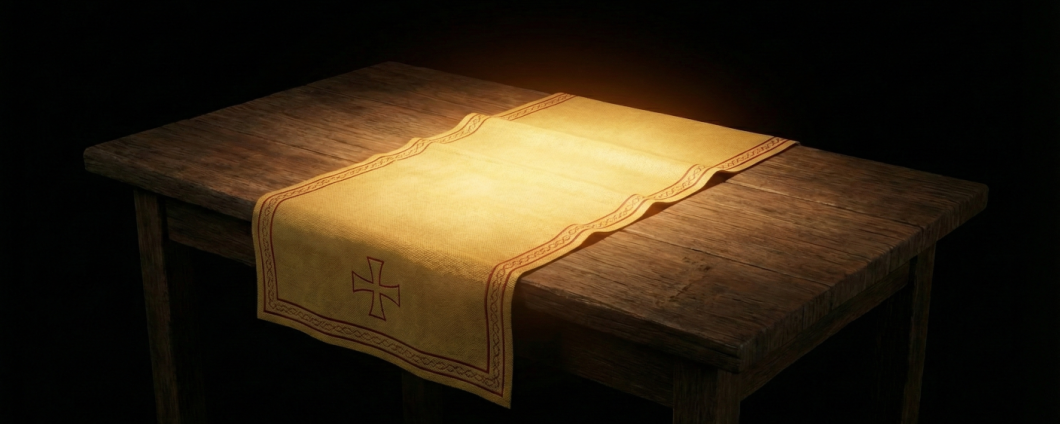
This is an ancient Christian understanding, preserved across traditions. In the Eastern churches, when an antimension (a consecrated cloth containing relics) is unfolded upon an ordinary table, that table becomes an altar. The space around it becomes a temple. When the liturgy concludes, and the antimension is folded away, the table returns to ordinary use. Sacredness is not inherent in the wood; it emerges through consecration and the Church’s sacramental action.
The same principle appears in Western tradition. Medieval missionaries carried portable altars into pagan lands, establishing sacred space wherever they preached. Military chaplains throughout Christian history have celebrated Mass on improvised altars in fields, ships, and temporary camps. Monastic communities in transit, refugee churches fleeing persecution, circuit-riding clergy serving isolated communities: all have known how to create sacred space without permanent architecture.
What makes space sacred is not the building that contains it but the preparation that sanctifies it. Before the Eucharist can be celebrated, the space must be purified: blessed with water, censed with incense, and arranged according to proper geometry. The altar must be clothed with clean linens. Candles must be lit. The sacred vessels must be prepared. The celebrant must enter into recollection, gathering body, soul, and spirit into focused presence.
These acts of preparation do not merely decorate a space; they transform it. They withdraw it from profane use and dedicate it to divine purpose. They create the conditions for what Chevillon called l’opération: the theurgic action through which heaven descends to earth, through which the Infinite touches the finite, through which bread becomes Body and wine becomes Blood.
This transformation requires discipline, attention, and interior preparation far beyond what permanent architecture provides. A fixed sanctuary can become a place of routine, of automatic gesture, of liturgy performed by rote. The priest who enters the same building week after week can lose awareness of the miracle being enacted. But the celebrant who must consciously establish sacred space each time, who unfolds the antimension with deliberate reverence, who prepares each element with full attention, cannot forget that every Eucharist is a threshold event, a moment when the ordinary becomes extraordinary through divine operation.
Borrowed space, used temporarily and then returned to ordinary purpose, paradoxically focuses attention on what matters. The Church does not borrow holiness from walls built generations ago. It carries holiness within itself, in its fidelity to apostolic tradition, in the validity of its orders, in the grace that flows through sacramental action, in the conscious preparation of both space and celebrant.
This is not innovation but recovery: the rediscovery of what the early Church always knew. Sacred space is wherever the Church deliberately creates it through consecration, order, and the descent of grace into matter made ready. No building, however ancient or beautiful, confers this. Only authentic sacramental action, celebrated with proper authority and interior preparation, makes a space holy.
Three Modes of Sacred Space
Christian tradition recognizes multiple legitimate modes of sacred space, each with its own character and purpose. These are not ranked hierarchically; they are different expressions of the same sacramental reality.
First, the permanent sanctuary: a building set apart exclusively for worship, consecrated by a bishop, and maintained across generations. This is the ideal toward which many communities aspire and the reality many enjoy. Permanent sanctuaries offer stability, continuity, and architectural testimony to faith’s enduring presence. They become landmarks in the landscape, centers of community life, repositories of memory and tradition. The Old Templar Church honors this mode and would welcome such a sanctuary if circumstances permit. There is nothing inferior about aspiration toward permanence.
Second, the tabernacular, or borrowed, space: worship celebrated in a location not permanently dedicated to this purpose, but temporarily prepared and consecrated. This includes using a funeral home chapel for monthly Mass, arranging seasonal celebrations in borrowed church space, or preparing a home or hall for the Eucharist. Here, the sacred vessels are portable, the altar is set up anew each time, and the space reverts to ordinary use after worship concludes. This mode requires more labor than the first; everything must be set up and broken down at each celebration. But it offers flexibility, allows worship to follow the faithful rather than requiring them to come to a fixed location, and preserves mobility when circumstances do not yet permit permanence.
Third, the living sanctuary: worship that happens where the faithful are, in the most immediate sense. This includes the Daily Office prayed in private homes, family prayer at the domestic altar, spiritual direction offered in ordinary conversation, and the reading of scripture in daily life. The Church has always recognized that not all sacred action requires a formal liturgical gathering. The baptized person carries the temple within; the illumined conscience is itself an altar where the Infinite meets the finite. Chevillon taught this with exceptional clarity: the Living Temple is not only the institutional Church but the purified soul in which divine presence dwells.
These three modes coexist without contradiction. A church might have no permanent building but maintain both tabernacular worship and domestic practice. A community with a permanent sanctuary continues to encourage daily prayer at home altars. A solitary Christian practicing the Office in their apartment participates in the same liturgical life as the priest celebrating Mass in a cathedral. The modes differ in form, not in validity or spiritual efficacy.
What matters is not which mode a particular community employs at a given time, but whether that mode is undertaken with integrity. Permanent sanctuaries can become places of routine rather than reverence. Borrowed spaces can foster discipline and intentionality. Living sanctuaries can deepen personal holiness in ways that no institutional structure can provide. The measure of authenticity is not architectural permanence but fidelity to the sacramental order, preparation of the space and the celebrant, and the Church’s conscious awareness that it is enacting something sacred.
The Living Temple
The term “Living Temple” appears throughout Chevillon’s writings as his central metaphor for both the Church and the reintegrated soul. It is not decorative language but a precise theological description.
For Chevillon, the Church is not primarily an organization but an organism: a living body in which divine life circulates, a threshold where the eternal breaks into time, a temple not built with human hands but constructed through the progressive transformation of souls. The Church exists wherever the baptized consciously gather in Christ’s name, wherever the sacraments are celebrated with authentic orders and proper intention, wherever the work of reintegration is undertaken through prayer, study, and ethical discipline.
This Living Temple is mobile by nature. It is not confined to geography or dependent on property ownership. It arrives where it is prepared, descends where order and readiness exist, and manifests wherever the conditions for its appearance are established through consecration and fidelity.
At the individual level, the same principle applies. Chevillon taught that conscience itself is an altar. Not conscience in the modern therapeutic sense of subjective feeling, but conscience in the ancient Christian sense: the inner sanctuary where the soul encounters God, the place where truth makes itself known directly, the threshold where divine presence is perceived without mediation.
This interior altar requires the same preparation as the physical altar demands. The soul must be purified through self-examination, through confession of what distorts and obscures, through the progressive release of attachment to false identity. The mind must be ordered through study, through contemplation of sacred texts, through the discipline of focused attention. The will must be aligned through practice: through works of charity that embody love rather than merely profess it, through the keeping of spiritual discipline even when feeling absent, through perseverance in prayer when prayer seems empty.
When these preparations are made, the interior altar becomes active. The Infinite descends to the finite not only in the sacramental elements on the physical altar but in the purified consciousness of the individual soul. Reintegration occurs here: the scattered self begins to gather, l’individu’s disordered dominance yields to la personne, and the soul begins its return from dispersion toward divine unity.
This is why Chevillon could be simultaneously a bank employee and a bishop, a man of ordinary occupation and a mystic, a contemplative and a correspondent. His real sanctuary was interior. The Living Temple was built within him through decades of daily discipline: prayer, study, ethical responsibility, sacramental participation, and progressive purification. When he celebrated the Eucharist, he stood at both altars simultaneously: the physical altar where bread and wine were consecrated, and the interior altar where his own consciousness became a threshold for divine descent.
The Church as Living Temple follows the same pattern. It is wherever the faithful are, wherever authentic sacramental life is maintained, wherever the work of reintegration is undertaken with seriousness. It requires no building to exist, though it may use buildings when available. It needs no permanent address to be real, though it may establish one when circumstances permit. What it requires absolutely is fidelity: fidelity to apostolic tradition, fidelity to sacramental order, fidelity to the interior work that alone makes external celebration meaningful.
Liturgy, Authority, and Discipline
The flexibility of the worship space should not be mistaken for casualness or improvisation. If anything, worship in a temporary or borrowed space requires more discipline, not less. The absence of routine demands heightened attention. The lack of permanent infrastructure requires systematic preparation. The need to establish sacred space fresh each time prevents the slide into automatic gesture.
Consider what happens when a church possesses a permanent sanctuary. The space is always there, already consecrated, already arranged. The priest arrives, vests, and begins. Repetition breeds familiarity: familiarity can breed routine. The celebrant who enters the same sanctuary weekly can lose awareness of the miracle being enacted. The gestures become mechanical, the words become recited rather than prayed, and the entire liturgy can be performed competently while the mind wanders elsewhere. Permanence, while offering stability, can permit complacency.
Now consider what happens when sacred space must be established fresh each time. The celebrant cannot arrive and simply begin. First, the space must be assessed: is it suitable, is it clean, does it allow proper arrangement? The altar must be set up with attention to orientation and geometry. The linens must be spread with care. The vessels must be unpacked, verified, and prepared. Water must be blessed, incense must be readied, candles must be lit. Every element requires conscious attention.
This preparation is not merely logistical. It is liturgical in the deepest sense: it is the work of creating a threshold, of withdrawing space from profane use and dedicating it to divine purpose. Each act of preparation is itself an act of worship, requiring the celebrant to focus attention, to recall the solemnity of what will follow, to enter into recollection before the proper liturgy even begins.
The discipline continues throughout the celebration. In a permanent sanctuary, one can rely on institutional memory, on established practice, on the accumulated tradition of how things have always been done. In a temporary space, nothing can be assumed. Every element must be deliberately arranged, every gesture consciously performed. The celebrant must hold the entire liturgical structure in awareness, remember where each element is, and maintain focus from beginning to end, because distraction or forgetfulness has immediate consequences.
This heightened discipline serves authentic sacramental life. It prevents reducing liturgy to routine. It ensures that each celebration is approached with the reverence and attention it deserves. It makes visible what permanent architecture often obscures: that every Eucharist is extraordinary, that every Mass is a threshold event where heaven touches earth, that bread truly becomes Body through an operation that should never become casual.
Authority functions differently as well. In an established parish with weekly services, priestly authority can become administrative, encompassing the management of schedules, coordination of volunteers, building maintenance, and financial management. These are legitimate responsibilities, but they are secondary to the priest’s primary work. In contrast, when worship is celebrated intentionally rather than routinely, priestly authority returns to its essential form: the authority to consecrate, to bless, to absolve, to teach. The priest’s role becomes clearer: not manager of an institution but mediator of sacramental presence.
This does not mean every church must choose temporary space or avoid permanence. It means that the absence of permanent architecture need not diminish sacramental integrity. What diminishes integrity is casualness, improvisation without preparation, and flexibility mistaken for disorder. A church that celebrates the liturgy occasionally but with full preparation, proper authority, and conscious reverence maintains higher standards than a church that celebrates weekly out of habit rather than intention.
The Old Templar Church understands this distinction. Our liturgies are announced in advance, not because we lack commitment but because we maintain intentionality. Spaces are prepared carefully before the celebration. Clergy approach each liturgy with the same preparation they would bring to celebrating in a cathedral. The absence of a weekly routine does not signal casualness; it signals deliberateness. We celebrate when we are ready, where we are prepared, with the full weight of sacramental seriousness.
This approach honors the mystery. The Eucharist is not a regularly scheduled program but an extraordinary event that happens whenever the Church enacts it with proper authority and conscious presence. To celebrate it intentionally, in spaces prepared with care, with full attention to what is being enacted, is to treat it with the reverence it deserves.
Practice Without Apology
How, practically, does The Old Templar Church maintain sacramental life without a permanent sanctuary? The answer is straightforward: through preparation, communication, and disciplined practice.
Services are scheduled and announced in advance. Major feast days are planned months in advance; celebrants coordinate with the faithful regarding attendance; locations are secured and prepared in accordance with established standards. Those who wish to participate know when and where worship will occur. There is no confusion about access, no mystery about availability. What varies is not the availability of sacramental life but its scheduling and location.
When a space is secured, it is prepared in accordance with liturgical requirements. If we celebrate in a funeral home chapel, the space is arranged properly: the altar is positioned correctly, linens are spread with care, vessels are prepared, candles are lit, and incense is readied. If we celebrate in a borrowed church, we work with what the space provides while ensuring that nothing essential is omitted. If circumstances require establishing a temporary sacred space, we do so according to the traditional rite: consecrating the antimension, blessing the space, and creating the conditions for valid celebration.
This preparation is never rushed or casual. The celebrant arrives early, assesses the space, makes necessary arrangements, and enters into interior recollection before the assembly gathers. Servers are instructed in their roles. Those attending know what to expect. The liturgy proceeds according to proper order, with full rubrics observed and appropriate solemnity maintained.
After the celebration, the space is returned to its original state. Vessels are cleaned and stored properly. Linens are folded with care. The altar is dismantled or left as found. Nothing is left in disarray. The Church honors the spaces it uses by treating them with respect, maintaining them properly, and restoring them when they are no longer in use.
This practice avoids two opposite errors. It avoids clerical inflation: the temptation to celebrate liturgy constantly, to make every gathering an occasion for Mass, to treat sacramental celebration as routine rather than extraordinary. It also avoids casualization: the reduction of the liturgy to an informal gathering, the loss of reverence, and the erosion of proper order. By celebrating intentionally rather than constantly, we maintain both the solemnity liturgy deserves and the practical discipline it requires.
The result is not absence but presence: real sacramental life, celebrated with proper authority, in spaces prepared with care, at times announced clearly, according to standards that honor the mystery being enacted. This is not a provisional compromise awaiting better circumstances. It is a deliberate practice, chosen consciously, undertaken with full awareness of its theological grounding and historical precedent.
Wayfarers and Distance Formation
Geography presents its own challenges. Not everyone lives near where our liturgies are celebrated. Some encounter the tradition through reading, through correspondence, through online exploration. They feel drawn to this path but have no physical proximity to the community. How does the Church serve those who cannot regularly attend in person?
The answer is the Wayfarer Program, designed specifically for those called to this tradition but distant from geographic community. The program provides formation through correspondence, spiritual direction at a distance, liturgical resources for home use, and connection to the wider Church through communication and, when possible, occasional in-person gatherings.
Distance formation follows the same four-phase catechetical structure as in-person formation, adapted for correspondence learning. Wayfarers work through the curriculum with a formation director through written assignments, scheduled video calls, and regular check-ins. The pace is flexible, adjusted to individual circumstances, but the content and standards remain identical. Distance does not diminish formation; it requires different methods for delivering the same substance.
Spiritual direction also happens at a distance for many Wayfarers. Directors meet with directees through video conferencing, exchange letters or emails between meetings, and maintain the same confidentiality and care they would provide in person. The medium differs; the relationship’s integrity does not.
For sacramental life, Wayfarers are encouraged to attend when possible, but are not held to regular attendance expectations that would be unrealistic given their distance. When they do attend, they are welcomed fully into the community’s worship. In addition to in-person participation, they maintain spiritual discipline through the Daily Office, through scripture reading, and through practices of examination and prayer. The Church provides resources, guidance, and connection; Wayfarers provide commitment and discipline.
This model acknowledges reality: not everyone can relocate to be near a community, not every community has a local presence everywhere seekers arise. Rather than pretending otherwise or refusing formation to those at a distance, the Church extends its reach through adapted means while maintaining the same standards of formation, direction, and sacramental integrity.
The Wayfarer path is not second-class membership. It is a legitimate expression of belonging, suited to specific circumstances. Some Wayfarers eventually relocate and become active in the local community. Others remain Wayfarers permanently, maintaining a connection at a distance while living their vocations where they are. Both patterns honor the principle that the Church exists wherever the faithful are, not only where buildings stand.
Reframing the Concern
The question “Where do you meet?” often carries an unstated concern: can a church without a permanent building truly be stable, serious, legitimate? The concern is understandable but misdirected. Stability does not come from architecture; it comes from fidelity. Seriousness is not measured by property ownership but by disciplined practice. Legitimacy is not conferred by visibility but by valid orders, authentic sacraments, and continuity with apostolic tradition.
The Church is not absent when it is not housed. It is not invisible when it lacks a permanent address. It is not unstable when it celebrates in borrowed space. The Church is wherever the baptized gather in Christ’s name, wherever valid sacraments are celebrated, wherever the work of reintegration is undertaken with seriousness and discipline. This has always been true; modern assumptions about permanence and architecture do not change ancient reality.
Mobility is not instability. The early Church was profoundly mobile, carrying its sacred life through persecution and dispersion. Military chaplains maintain full sacramental ministry while moving constantly. Circuit-riding clergy serve vast territories without a permanent base. Monastic communities in exile preserve their traditions across generations despite displacement. Mobility, approached with discipline and intention, can serve authentic Christian life as effectively as permanence, sometimes more so.
The difference lies not in whether a church has a building, but in whether it maintains fidelity: fidelity to apostolic tradition, fidelity to the proper sacramental order, fidelity to the interior work that makes external celebration meaningful, and fidelity to the theological vision that defines its identity. The Old Templar Church maintains this fidelity. We preserve valid orders through documented succession. We celebrate sacraments according to the proper rite. We maintain standards of formation that require years of sustained engagement. We practice spiritual discipline rooted in Chevillon’s integrated vision. These constants do not change regardless of where liturgy is celebrated.
A church can own magnificent architecture and yet lack interior depth. It can maintain weekly schedules while performing liturgy by rote. It can occupy the same building for centuries and yet drift from its founding vision. Conversely, a church can celebrate in borrowed spaces and yet maintain profound sacramental integrity. It can lack permanent headquarters and yet preserve authentic tradition with complete fidelity. The measure is interior, not exterior; spiritual, not material; theological, not architectural.
This reframing matters because it returns attention to what actually constitutes the Church. The Church is not real estate. It is not an organization defined by property holdings. It is the Body of Christ, animated by the Holy Spirit, carrying within itself the Living Presence that no building can contain. When this is remembered, the question “Where do you meet?” receives its proper answer: “Wherever we prepare space to receive what descends, wherever we gather in conscious awareness of the mystery, wherever we enact the sacramental life that makes us who we are.”
Conclusion: Presence Over Property
The Old Templar Church would welcome a permanent sanctuary. We do not romanticize the lack of property or pretend that permanent architecture offers no benefits. Stability has value. Continuity matters. A fixed location serves the faithful who seek consistent access. When circumstances permit, and resources allow, establishing permanent sacred space is a worthy aspiration.
But we will not equate presence with property. We will not measure ecclesial authenticity by architectural permanence. We will not pretend that buildings make churches; rather, churches make buildings sacred through their use.
Until permanent sanctuary becomes possible, we maintain sacramental life with full integrity in borrowed, temporary spaces, prepared with care and used with reverence. We celebrate the liturgy according to proper order, with valid authority, at times clearly announced, in places consciously prepared. We offer formation to those near and far through a structured curriculum and spiritual direction. We preserve the Chevillonian vision with complete fidelity, transmitted through authentic succession, embodied in disciplined practice, and offered to all who are called.
This is not a provisional compromise. It is faithful practice, grounded in theological understanding, validated by historical precedent, and undertaken with conscious awareness of what the Church has always been. The Living Temple is not waiting for a building to be realized. The Living Temple is present wherever the Church enacts its sacramental life with fidelity, preparation, and the conscious awareness that every liturgy is an extraordinary event, regardless of where it occurs.
The temple is not made of stone. It is built of living stones: souls progressively purified, consciousnesses progressively illuminated, lives progressively transformed through the work of reintegration. This temple can be carried anywhere. It arrives wherever the Church prepares space to receive it. It descends wherever order, intention, and grace converge.
We do not apologize for mobility. We practice it with discipline. We do not lament the absence of permanent architecture. We prepare a temporary space with the same reverence we would bring to a cathedral. We do not treat borrowed sanctuaries as second-best. We honor them as sufficient for the sacred action they contain.
The Church exists. It lives. It carries the mysteries. It celebrates the sacraments. It forms souls. It maintains tradition. It does all this without needing to own the spaces where these actions occur, just as the early Church did for three centuries, just as persecuted Christians have done throughout history, just as the faithful in countless contexts continue to do today.
Fidelity is the measure. Preparation is the requirement. Presence is the reality. These do not depend on architecture. They depend on the Church’s conscious awareness of what it is and what it carries, maintained through discipline and enacted wherever space can be properly prepared to receive what descends.
This is the Old Templar Church’s practice. This is our present reality. This is how the Living Temple manifests when buildings are not yet possible. And this, we believe, is authentic Christian witness: faithful to tradition, grounded in theology, disciplined in practice, and confident that the mysteries we carry are not diminished by being celebrated in borrowed rooms rather than permanent sanctuaries.
The temple arrives at its site of preparation. We prepare it wherever we are called to serve. And in that preparation, that celebration, that fidelity, the Church is fully present.
Lux · Veritas · Caritas
