Alchemy and the Structure of Initiation
Across many traditions of spiritual life, one intuition appears again and again: the human person is unfinished.
People sense within themselves the possibility of coherence, depth, and truth. Yet they also encounter contradiction, confusion, and fragmentation. Aspirations toward wisdom or goodness exist alongside impulses that undermine them. Insight does not automatically become action. Desire does not always follow conviction.
The traditions of initiation arise from this recognition. They assume that transformation is possible, but also that it requires labor.
Among the symbolic languages developed to describe this labor, few are as enduring as alchemy.
Alchemy has often been misunderstood as a primitive attempt at chemistry or as a romantic collection of mystical images. Yet beneath its imagery lies a remarkably sober anthropology. The alchemists began from the premise that the material placed in the furnace was not already pure. It was mixed, unstable, and opaque. Only through sustained operations could its hidden potential emerge.
The same logic applies to the human condition.
Alchemy speaks first of prima materia, the original substance from which the Work begins. This substance contains the possibility of gold, yet it appears dark, disordered, and confused. It must be heated, dissolved, separated, washed, and recombined.
Spiritually understood, prima materia is the human person as actually found. It is the self shaped by memory, fear, habit, and desire. It is the self that believes itself unified while being pulled in multiple directions at once.
One part of the person seeks truth while another seeks comfort. One part desires integrity while another protects reputation. One part longs for compassion while another quietly defends resentment.
This condition is not merely moral weakness. It is structural fragmentation.
The tradition names this condition with precision. What the alchemists called prima materia corresponds to what Chevillon named l’individu: the self that is constructed through fear, habit, and the illusion of self-sufficiency. It is not the person as God made them, but the person as fear has shaped them. Chevillon set beside it la personne: the spiritual hypostasis that exists in transparent relationship with its divine origin. The Great Work, on this understanding, is the progressive disciplining of l’individu’s dominance and the emergence of la personne. It is not self-improvement but ontological restoration.
The alchemists insisted that transformation begins by acknowledging this mixture. They called the first stage of the Work nigredo, the blackening.
Nigredo represents reduction. The material is placed in the furnace, where heat reveals what is unstable. Structures dissolve. Hidden elements surface. What appeared solid becomes uncertain.
In interior life, this stage often arrives as a confrontation with one’s own contradictions. Certainties weaken. Motivations become ambiguous. Patterns that once seemed harmless reveal deeper consequences.
The blackening does not destroy the material. It clarifies it.
Without reduction, mixture remains mixture. Without exposure, fragmentation remains hidden beneath habit and distraction. The furnace forces honesty.
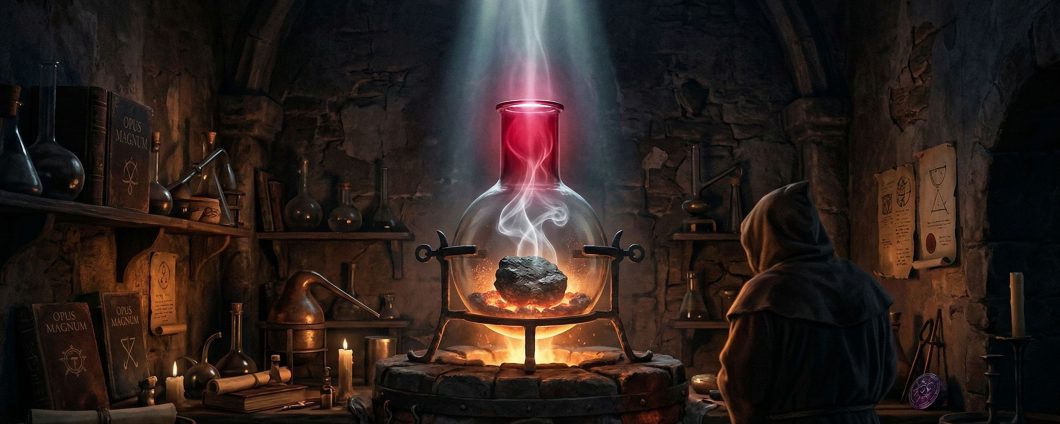
Yet the furnace alone cannot accomplish the Work. The alchemists placed great importance on the vessel in which the material was sealed. Without containment, the process would scatter and fail.
The vessel symbolizes discipline.
Silence, study, ethical commitment, prayer, and contemplative practice create the conditions for transformation to unfold. These practices hold the material steady so that heat can operate without dispersing the elements of the self.
Many abandon the Work at this stage because reduction feels like loss. Identity trembles. Familiar structures weaken. Yet this reduction prepares the way for the next operation.
Following nigredo comes albedo, the whitening.
If blackening reveals disorder, whitening begins the labor of purification and discernment. The material is washed repeatedly. Impurities are separated. What is stable is preserved.
Spiritually understood, albedo corresponds to the gradual emergence of clarity. The person begins to distinguish impulse from intention, fear from insight, and passing emotion from deeper conviction.
The inner life becomes cleaner.
Not in the sense of moral perfection, but in the sense of increased transparency. The person becomes less governed by hidden reactions and more capable of conscious choice. The will steadies. Attention becomes more stable. Integrity becomes possible.
The alchemists often described this stage as the purification of the material so that it might become capable of receiving light.
Finally, the Work reaches rubedo, the reddening.
Rubedo represents integration. The purified material becomes radiant. What has endured reduction and washing becomes capable of transmitting light rather than distorting it.
In human terms, this is the emergence of maturity. Intellect, will, memory, and desire begin to operate in harmony. The person becomes less reactive and more stable. Actions reflect conviction rather than impulse.
The alchemical gold symbolizes incorruptibility. It does not decay under ordinary conditions. Likewise, the integrated person remains steady under pressures that once would have produced confusion or collapse.
It is important to note that this transformation does not eliminate individuality. Alchemical gold remains matter. It is matter refined and stabilized. The same is true of human transformation. The person remains fully human while participating in a deeper coherence of being.
Another important feature of the Great Work is its cyclic nature.
Nigredo, albedo, and rubedo do not occur once and conclude forever. They recur at deeper levels. New experiences introduce new material into the vessel. Patterns that once seemed resolved may reappear in subtler form.
This repetition is not failure. It is refinement.
Each cycle strengthens the vessel. Each encounter with the furnace clarifies finer distortions. What would once have shattered now purifies.
The Great Work, therefore, unfolds as a spiral of increasing depth.
Alchemy also preserves a profound humility about transformation. The alchemists repeatedly depicted celestial forces descending into the vessel. Sun and moon pour influence into the material from above.
This imagery expresses an important insight. The finite cannot produce the infinite by accumulation. Human effort prepares the vessel, but illumination is received.
Transformation requires participation in a higher coherence.
The Work, therefore, combines discipline and receptivity. The vessel must be carefully prepared, yet the fire that transforms is not identical with human ambition.
Finally, the alchemists insisted that the goal of the Work was not escape from the world.
The gold that emerges from the furnace is still material. It becomes useful for sacred architecture and ornament. Transformation intensifies presence rather than negating it.
The same principle applies to human life. The integrated person does not withdraw from responsibility but becomes capable of bearing it more fully. Service replaces self-protection. Fidelity replaces instability.
The stone that has been shaped is placed within the Temple.
The Great Work is therefore not merely personal improvement. It is the reconstitution of the person so that life may participate in a deeper order of being.
Yet a final question remains.
Alchemy speaks repeatedly of influence descending into the vessel. It suggests that higher coherence must enter the material if transformation is to be complete.
If that descent is real, where does it come from?
The next part of this series turns to a startling claim at the heart of Christianity. The descent that alchemy intuited symbolically is revealed historically in the mystery of the Incarnation.
Lux · Veritas · Caritas
