The Sacramental Laboratory
In the previous parts of this series, we explored two related claims.
First, the alchemical tradition describes a universal pattern of initiation. Human life begins in mixture and fragmentation. Through reduction, purification, and integration, the person becomes capable of participating in a deeper coherence of being.
Second, the Christian proclamation reveals that the descent anticipated symbolically by alchemy has already occurred. In the Incarnation, the Divine does not merely influence the world from a distance but enters fully into the conditions of human existence. Through the Cross, Resurrection, and Pentecost, the pattern of transmutation becomes a historical reality.
If these two claims are taken seriously, a new question naturally follows.
Where does the Great Work continue now?
Christianity answers this question in a way that might at first seem surprising. The ongoing transformation of human life does not occur primarily through abstract philosophy or private mystical experience. It unfolds within the sacramental life of the Church.
The Church becomes the living vessel of transmutation.
Speaking of the Church in this way is not to reduce it to an institution or organization. In the deepest theological sense, the Church is the Body through which the Incarnate life of Christ continues to act within history. The same fire that descended at Pentecost has not vanished. It continues to operate wherever the life of Christ is faithfully enacted.
For this reason, the sacramental life of the Church can be understood as the true laboratory of the Great Work.
The language of the laboratory may seem unusual in a spiritual context, yet it captures something essential about the sacramental imagination. A laboratory is a place where processes occur, where material is subjected to particular conditions so that transformation becomes possible. The sacraments do not merely symbolize transformation. They enact the conditions in which transformation unfolds.
Consider Baptism.
Water is among the most ancient symbols of dissolution. It washes, dissolves, and renews. In the Christian tradition Baptism represents entry into the death and resurrection of Christ. The initiate descends into water and emerges into a new life.
In alchemical terms this is the beginning of the Work.
The person who enters the waters of Baptism does not simply adopt a new religious identity. Something more profound is claimed. The old patterns of existence are exposed to reduction. The initiate enters a life in which transformation becomes possible because participation in Christ has begun.
The symbolism is clear. Water dissolves what cannot endure and prepares the material for further purification.
Yet Baptism alone does not complete the Work. Just as the alchemical process involves repeated operations, Christian initiation unfolds through continuing participation in sacramental life.
The Eucharist stands at the center of this life.
Bread and wine are among the most ordinary elements of human nourishment. They represent the daily sustenance of life. Yet within the Eucharist, these elements become vehicles of divine presence. The faithful receive not merely symbolic reminders of Christ but communion with the living reality of His life.
In alchemical language, the Eucharist represents the moment when matter becomes transparent to spirit without ceasing to be matter.
The transformation does not occur by abandoning the material world. Instead, the material world becomes the medium through which divine life is communicated.
This insight lies at the heart of sacramental theology. The Divine does not bypass creation in order to reach humanity. Creation itself becomes the vessel through which grace operates.
The Eucharist, therefore, nourishes the Great Work.
Each participation in the sacramental meal deepens the alignment between the believer’s life and Christ’s life. Fragmentation gradually gives way to coherence. Self-centered patterns soften. Charity becomes possible.
Another sacramental dimension appears in the rite of anointing.
Throughout Scripture, oil signifies consecration. Kings, prophets, and priests are anointed as a sign that their lives have been dedicated to divine purpose. Oil also represents healing, protection, and illumination.
Within the sacramental life of the Church, anointing marks the human person as a vessel prepared for divine action. The material body becomes the place where grace is sealed.
In alchemical imagery, oil sometimes appears as a subtle essence that unifies the elements of the Work. In Christian symbolism, the anointing oil reminds us that transformation involves the whole person, body as well as soul.
These sacramental actions reveal a profound theological principle.
The Great Work is not accomplished by escaping the material world but by allowing matter itself to become the bearer of grace.
The Incarnation already demonstrated this truth. God entered the world not as a distant influence but as embodied life. The sacraments extend that same logic. Water, bread, wine, oil, and human touch become the instruments through which divine life continues to act.
This vision has deep consequences for how the Christian life is understood.
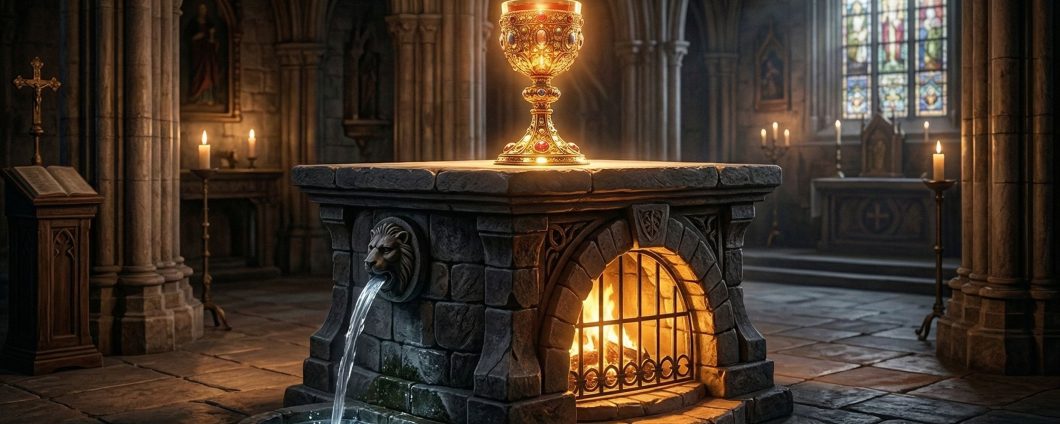
Transformation does not depend solely on extraordinary spiritual experiences. It unfolds through faithful participation in the rhythms of sacramental life. The altar becomes the place where the furnace of grace continues its work.
Within the Old Templar Church, this understanding shapes both theology and practice.
The initiatic language of the Temple reminds us that human beings are called to become living stones within a sacred structure. Each life must be shaped, purified, and aligned so that it may take its proper place within the greater architecture of the Kingdom.
The sacramental life reminds us that the Temple is not constructed solely by human effort. The presence of Christ animates the entire structure.
Chivalric commitment adds another dimension. The knightly spirit calls believers to embody courage, fidelity, and service. Transformation must express itself in action.
These three streams of initiate, sacramental, and chivalric form a single current within the life of the Church. Together they sustain the ongoing labor of transmutation.
The person who participates in this life discovers that the Great Work is not confined to dramatic moments of spiritual crisis or illumination. It unfolds quietly through daily fidelity.
The furnace may appear in unexpected places. A moment of conflict may reveal hidden pride. A difficult responsibility may expose the limits of patience. A season of silence may reveal how restless the mind has become.
Yet these experiences are not interruptions of spiritual life. They are part of the Work.
The sacraments provide the context in which these experiences can be understood and transformed. Confession becomes the place where the blackening of truth is embraced rather than avoided. The Eucharist becomes nourishment for renewed clarity and strength.
Over time, the believer discovers that spiritual maturity resembles the alchemical pattern described earlier. Periods of reduction are followed by purification. Purification gradually leads to integration.
The difference is that the Christian does not face the furnace alone.
The life of Christ surrounds the Work. The Spirit sustains it. The Church bears witness to it.
The Temple is therefore not only a metaphor. It is a living community in which the Great Work continues through shared prayer, sacramental participation, and faithful service.
This realization prepares us for the final question of the series.
If the Church is the vessel in which transmutation continues, what does it mean for each believer to live consciously within the Great Work?
The final part of this series will explore how the process of transformation becomes a daily path of life, shaping thought, action, and vocation.
For the fire that descended at Pentecost still burns.
And the work continues within us.
Lux · Veritas · Caritas
